
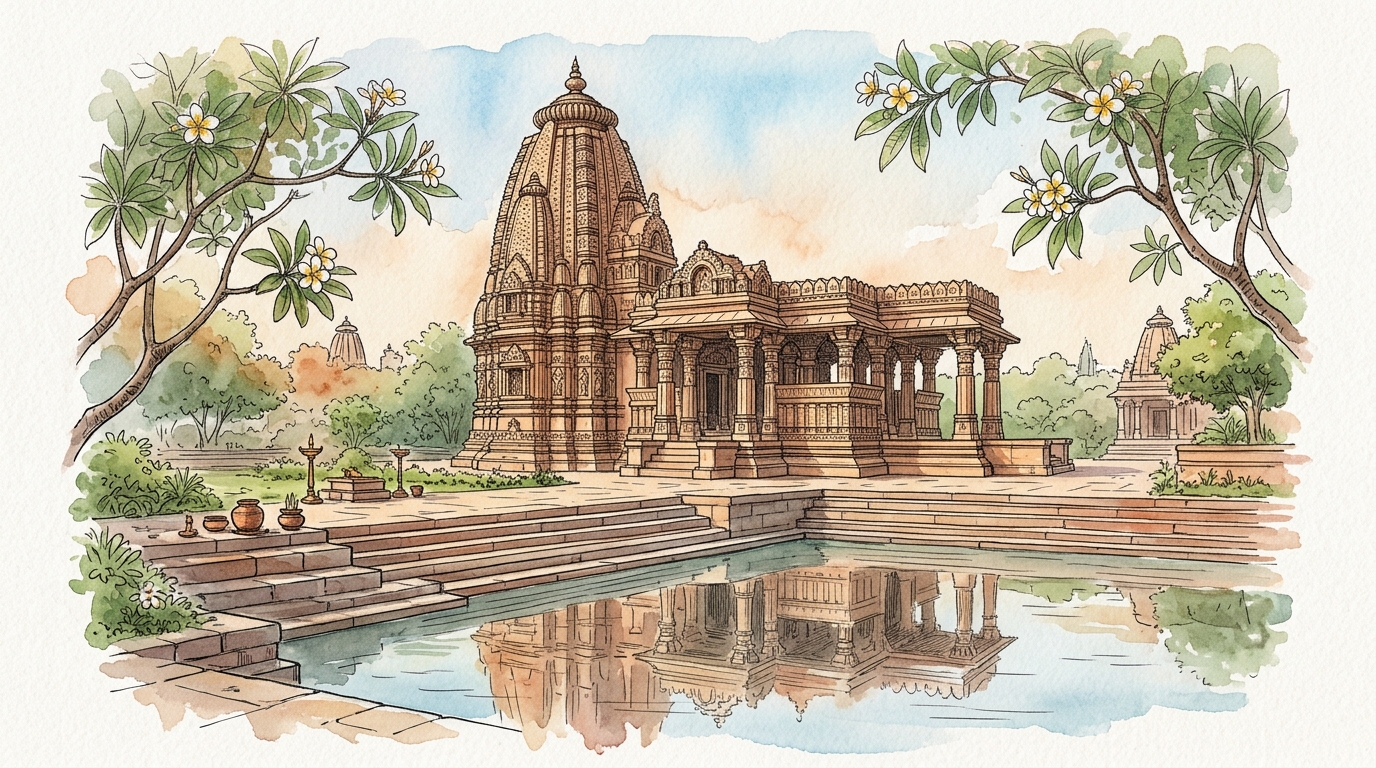
- Why UPSC Loves Temple & Bhakti Questions: Instead of asking rote lists of kings, UPSC Mains GS1 asks how art and devotional movements reflected socio-economic realities (e.g., "Chola temples as economic nuclei", "Nature of Bhakti literature and its contribution to Indian culture").
- 20-Second Shikhara vs Vimana Sketch: In any temple architecture question, draw two tiny side-by-side elevation sketches: (a) Curvilinear Nagara Shikhara (Rekha-Prasada with Amalaka & Kalasha on a high Jagati platform) and (b) Pyramidal stepped Dravida Vimana with a towering Gopuram gateway and temple tank (Kalyani).
- Bhakti & Sufi Vernacular Revolution: Broke Sanskrit/Persian liturgical monopolies by composing in Tamil (Alvars/Nayanars), Kannada (Basavanna’s Vachanas), Marathi (Varkari Abhangas), Awadhi/Braj (Kabir, Tulsidas, Surdas, Mirabai), and Punjabi/Kashmiri (Baba Farid, Bulleh Shah, Lal Ded).
1. Beyond Stone: Indian Temples as Socio-Economic & Cultural Nuclei
evolving from Gupta structural shrines (Dashavatara Temple at Deogarh) to the monumental Chola (Brihadeeswarar at Thanjavur), Chandela (Khajuraho), Eastern Ganga (Konark), and Hoysala (Belur/Halebidu) complexes, medieval Indian temples functioned as complete civic ecosystems:
Under the Cholas and Vijayanagara rulers, temples received tax-free land grants (Devadana), advanced rural credit to peasant assemblies (Ur and Sabha), and maintained tanks and canals.
Mandapas hosted Bharatanatyam, Odissi, and philosophical debates (Ghatikas/Mathas), while temple workshops perfected the Cire Perdue (lost-wax) Panchaloha bronze casting technique (exemplified by the cosmic Chola Nataraja).
2. The Bhakti-Sufi Movement: Democratizing Spirituality & Social Reform
Originating in 6th–9th century Tamilakam with the Vaishnava Alvars (Andal, Nammalvar) and Shaiva Nayanars (Appar, Sambandar, Karaikkal Ammaiyar), the Bhakti movement swept across India alongside Chishti and Suhrawardi Sufi silsilas:
Saints from artisanal and marginalized communities—Ravidas (cobbler), Kabir (weaver), Chokhamela, Sena, and Dadu Dayal—rejected birth-based pollution, asserting that personal devotion (Prem-Bhakti) and moral conduct supersede ritual priesthood.
Saint-poets like Andal, Akka Mahadevi, Lal Ded (Lalleshwari), Janabai, and Mirabai defied patriarchal household confinement, claiming direct spiritual agency in public vernacular verse.
Sufi Khanqahs (Moinuddin Chishti, Nizamuddin Auliya, Amir Khusrau) and Guru Nanak’s Langar/Sangat fostered syncretic music (Qawwali, Kirtan), linguistic flowering, and communal harmony (Sulh-i-Kul).
Nagara (North Indian) vs Dravida (South Indian) vs Vesara Temple Architecture (GS1 Matrix)
| Architectural Feature | Nagara Style (North India) | Dravida Style (South India) |
|---|---|---|
| Main Tower Above Garbhagriha | Curvilinear inward-curving Shikhara (Latina/Rekha-prasada) crowned byribbed Amalaka & Kalasha. | Stepped pyramidal tower called Vimana crowned by an octagonal dome-like Stupika/Shikhara. |
| Boundary Walls & Gateways | Generally lacks elaborate boundary walls; built on a high stone platform (Jagati). | Enclosed within high compound walls (Prakara) entered through monumental Gopuram gateways. |
| Water Tank & Sanctum Guards | Water tank rarely present inside complex; Ganga & Yamuna river goddesses carved at sanctum doorway. | Sacred water tank (Kalyani/Pushkarini) compulsory inside; fierce Dvarapalas guard the sanctum. |
| Regional Sub-Schools & Examples | Odisha (Lingaraja, Konark), Chandela/Khajuraho (Kandariya Mahadeva), Solanki (Modhera Sun Temple). | Pallava (Shore Temple), Chola (Brihadeeswarar, Gangaikondacholapuram), Vijayanagara (Vitthala). |
"The rock-cut architecture represents one of the most important sources of our knowledge of early Indian art and history. Discuss." Also practice: "Evaluate the nature of the Bhakti Literature and its contribution to Indian culture." (10 Marks, 150 Words)
Write this answer on paper and upload to Acme AI for On-Script Red-Pen Checking, or use our 1-Click Answer Generator to view a complete UPSC Model Answer alongside Semantically Similar PYQs & Topper Copies.
Frequently Asked Questions
What is the Vesara style of Indian temple architecture?
Flourishing in the Deccan region (Karnataka) between the 7th and 13th centuries under the Badami Chalukyas, Rashtrakutas, and Hoysalas (e.g., Chennakesava Temple at Belur and Hoysaleswara Temple at Halebidu), the Vesara style hybridizes the Nagara curvilinear plan and the Dravida tiered Vimana—often featuring stellate (star-shaped) platforms, soapstone lathe-turned pillars, and multiple shrines (Trikuta).