
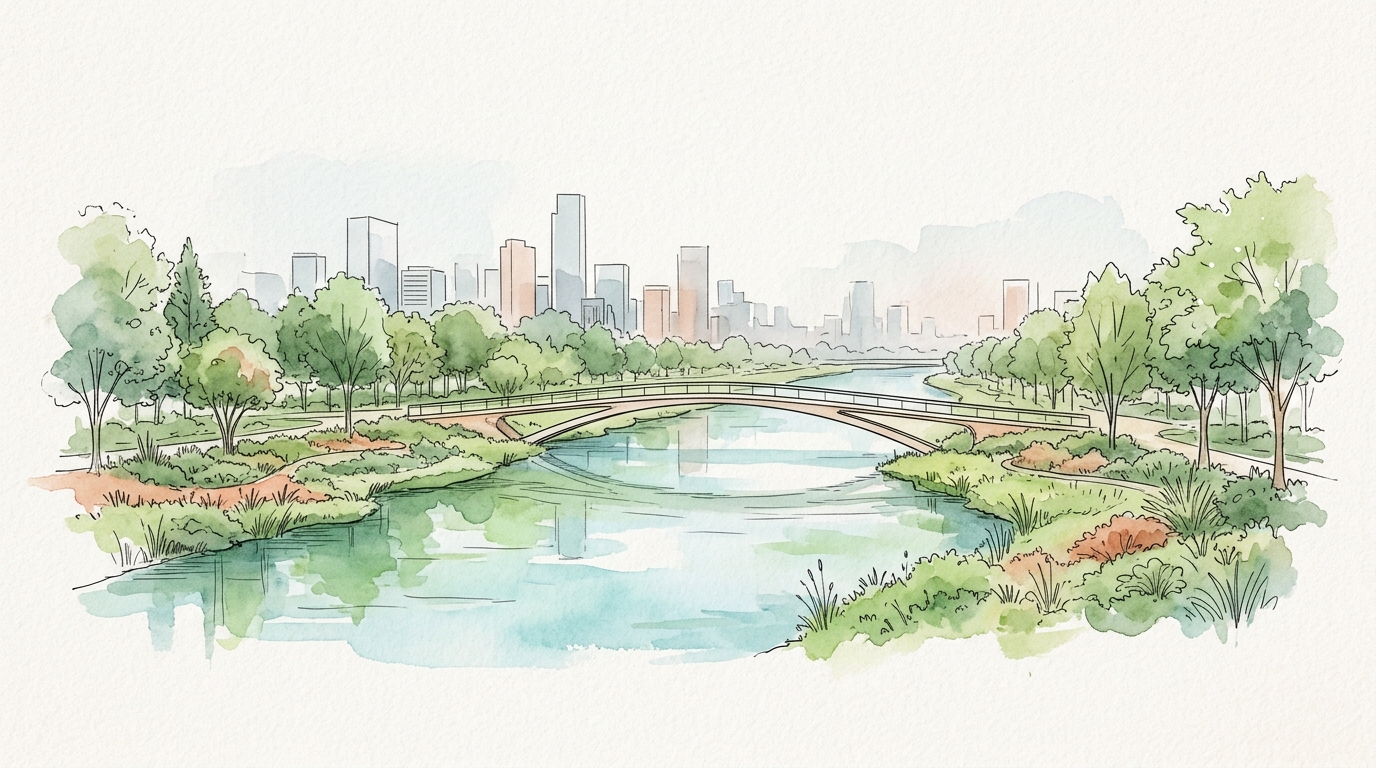
- Cross-Paper Multiplier: A single 1-page master note on Urbanization serves GS1 Society ("Urbanization, problems and remedies"), GS1 Geography (Urban Heat Islands & Water Stress), GS2 Governance (74th CAA / ULBs), and GS3 Disaster Management (Urban Flooding).
- Core Diagnostic ("Messy & Hidden Urbanization"): World Bank characterizes Indian urbanization as "messy" (65 million+ living in informal settlements/slums with inadequate transit/drainage) and "hidden" (rapid growth of Census Towns governed as rural panchayats without urban planning).
- Why Indian Cities Flood Every Monsoon: Anthropogenic encroachment of natural wetlands/lakes (e.g., Pallikaranai marsh in Chennai, Bellandur-Varthur lake chain in Bengaluru), concretization exceeding 80% impervious surface area, and storm-water drains designed for 1930s rainfall intensities (25 mm/hr) facing 100+ mm/hr cloudbursts.
- The "Sponge City + 3F" Way Forward: Combine ecological Sponge City infrastructure (bioswales, permeable pavements, wetland restoration) with institutional 74th Amendment empowerment (Funds via Municipal Bonds/Property Tax GIS, Functions under 12th Schedule, and Functionaries via empowered Mayors).
1. The Paradox of Indian Urbanization: Engines of Growth vs Crumbling Commons
Cities occupy barely 3% of India’s land area but generate over 60% of national GDP. According to NITI Aayog and UN-Habitat estimates, India will add over 400 million urban residents between 2020 and 2050—the largest urban transition in human history. Yet Indian urbanization exhibits a top-heavy "Metropolitan Skew" where Tier-1 megacities suffer acute congestion while Tier-2 and Tier-3 towns lack foundational master plans (65% of 7,933 urban settlements lack notified master plans, per NITI Aayog).
2. Twin Ecological Crises: Pluvial Urban Flooding & Urban Heat Islands (UHI)
UPSC Mains has asked about Urban Flooding and Urban Climate Resilience four times between 2016 and 2024. Structure your answer around the hydrological and thermal transformation of Indian cities:
In Bengaluru, interconnected cascading tanks (keres) once absorbed monsoon runoff; rapid real-estate encroachment reduced water bodies by 79% over four decades while built-up concrete area rose from 8% to over 85%.
Combined sewer-and-storm drains silted with unsegregated plastic waste fail during high-intensity convective downpours exacerbated by the Urban Heat Island aerosol effect.
Replace grey "pipe-and-pump" drainage with nature-based Sponge City infrastructure: urban wetland revival (AMRUT 2.0), permeable pavements, rooftop rainwater harvesting mandates, and GIS-mapped flood-plain zoning.
Grey Infrastructure Approach vs Sponge City & 74th CAA Empowered Urban Governance
| Urban Dimension | Conventional "Grey" Urban Planning | Resilient "Sponge City" & Empowered ULB Model |
|---|---|---|
| Stormwater & Flood Management | Concretizing natural nallahs and paving over lakes; relies on narrow underground pipes. | Restores cascading lake networks, bioswales, permeable surfaces, and urban sponge parks. |
| Micro-Climate & Heat | High-density glass-and-concrete towers trapping solar radiation (UHI +4°C spike). | Cool-roof mandates (Ahmedabad Heat Action Plan), urban forests (Miyawaki), and wind corridors. |
| Mobility & Spatial Form | Car-centric flyovers and ribbon sprawl along highways. | Transit-Oriented Development (TOD), 15-Minute Neighbourhoods, and NMT/EV bus corridors. |
| Municipal Finance & Governance | Fragmented parastatal agencies; ULBs dependent on state grants (< 1% of GDP own revenue). | Empowered Mayors, GIS-backed property tax, and Green Municipal Bonds (Indore/Ghaziabad model). |
"Account for the huge flooding of million-plus cities in India including the smart ones like Hyderabad and Pune. Suggest lasting remedial measures." Write your answer and check it with On-Script Red-Pen AI Evaluation + 1-Click Model Answer. (15 Marks, 250 Words)
Write this answer on paper and upload to Acme AI for On-Script Red-Pen Checking, or use our 1-Click Answer Generator to view a complete UPSC Model Answer alongside Semantically Similar PYQs & Topper Copies.
Frequently Asked Questions
What is a "Sponge City" in the context of UPSC Mains GS1 and GS3?
Coined by hydrologist Kongjian Yu, a Sponge City is an urban planning model where a city is designed to passively absorb, clean, and store monsoon rainwater like a natural sponge—using permeable pavements, interconnected wetlands, rain gardens, and green rooftops—rather than rapidly funneling runoff through concrete storm drains.