
Q.Ramesh is State Civil Services Officer who got the opportunity of getting posted to the capital of a border State after rendering 20 years of service. Ramesh’s mother has recently been detected cancer and has been admitted in the leading cancer hospital of the city. His two adolescent children have also got admission in one of the best public schools of the town. After settling down in his appointment as Director in the Home Department of the State, Ramesh got confidential report through intelligence sources that illegal migrants are infiltrating in the State from the neighbouring country. He decided to personally carry out surprise check of the border posts along with his Home Department team. To his surprise, he caught red-handed two families of 12 members infiltrated with the connivance of the security personnel at the border posts. On further inquiry and investigation, it was found that after the migrants from neighbouring country infiltrate, their documentation like Aadhaar Card, Ration Card and Voter Card are also forged and they are made to settle down in a particular area of the State. Ramesh prepared the detailed and comprehensive report and submitted to the Additional Secretary of the State. However, he has summoned by the Additional Home Secretary after a week and was instructed to withdraw the report. The Additional Home Secretary informed Ramesh that the report submitted by him has not been appreciated by the higher authorities. He further cautioned him that if he fails to withdraw the confidential report, he will not only be posted out from the prestigious appointment from the State capital but his further promotion which is due in near future will also get in jeopardy. (a) What are the options available to Ramesh as the Director of the Home Department of the bordering State? (b) What option should Ramesh adopt and why? (c) Critically evaluate each of the options. (d) What are the ethical dilemmas being faced by Ramesh? (e) What policy measures would you suggest to combat the menace of infiltration of illegal migrants from the neighbouring country?
How to approach: Anchor your answer around measurable outcomes: where the policy succeeded, where implementation faltered, and what institutional course-correction is needed.
Practice & AI Tools for This Question
Wrote an answer to this PYQ? Check it with Acme AI in 3 mins or generate custom mind maps.
Matched Topper Handwritten Answer Copies (8)
Open in 3D PYQ RealmSyllabus Point
GS Paper IV: Case Studies on National Security, Civil Service Neutrality, Moral Courage, and Personal vs Public Duty.
Approach
- Directive: Analyze the ethical dilemma faced by Ramesh, evaluate available options, recommend the best course of action with justification, and suggest policy measures to address illegal infiltration.
- Core Demand: Address all sub-parts: (a) options, (b) recommended option and justification, (c) critical evaluation, (d) ethical dilemmas, and (e) policy measures.
- Structure: Introduction framing the conflict, followed by body sections covering stakeholders, dilemmas, options, evaluation, recommended action, and policy measures, concluding with value addition and a summary.
Introduction
Ramesh faces a profound ethical dilemma between upholding national security and personal well-being. This case highlights the conflict between a civil servant's constitutional duty to the state and the pressures of career progression and family responsibilities, testing his moral courage and integrity.
Body
1. Stakeholders & Ethical Dilemmas Involved
- Stakeholders: Ramesh, his family, illegal migrants, corrupt security personnel, Additional Home Secretary, higher authorities, citizens of the State, neighbouring country.
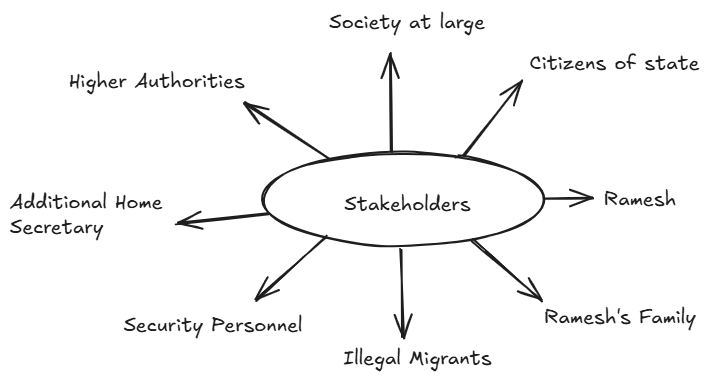 ✏️ Ramesh Stakeholder Diagram
- Ethical Dilemmas:
- Duty vs. Personal Interest: National security vs. family welfare (mother's health, children's education, prestigious posting).
- Loyalty to Superiors vs. Constitutional Duty: Following orders vs. upholding truth, public interest, and rule of law.
- Integrity vs. Career Security: Risking promotion and posting for exposing corruption and fulfilling duty.
- Public Welfare vs. Organisational Silence: Reporting critical security threat vs. covering it up under pressure.
 ✏️ Fig: Stakeholder & Ethical Dilemma Map: Ramesh Border Infiltration & Political Pressure Case
2. Options Available to Ramesh
- Option 1: Withdraw the Report: Succumb to pressure, prioritize personal gain and family stability.
- Option 2: Stand Firm: Refuse to withdraw, uphold duty, and face potential adverse consequences.
- Option 3: Escalate the Matter: Inform higher authorities (e.g., Chief Secretary, Ministry of Home Affairs) through formal channels.
- Option 4: Seek Whistleblower Protection/Media Leak: Discreetly expose the issue to media or relevant agencies.
3. Critical Evaluation of Options
- Option 1 (Withdraw):
- Pros: Secures career, family stability.
- Cons: Violates professional ethics, constitutional duty, national security, personal integrity; sets poor precedent.
- Option 2 (Stand Firm):
- Pros: Upholds constitutional values, integrity, accountability.
- Cons: Risks transfer, harassment, personal/family hardship, isolation within the system.
- Option 3 (Escalate):
- Pros: Formal channel, bypasses immediate superior, involves constitutional authorities, demonstrates moral courage.
- Cons: May be seen as disloyal, outcome uncertain, potential for retaliation.
- Option 4 (Whistleblower):
- Pros: Public pressure, potential for systemic change.
- Cons: Weak protection mechanisms, career/safety risk, politicization, procedural breach.
4. Most Appropriate Course of Action & Justification
- Option to Adopt: Option 3: Escalate the matter to higher authorities (e.g., Chief Secretary, Ministry of Home Affairs).
- Justification:
- Constitutional Duty: Upholds allegiance to the Constitution and national security, not just superiors.
- Integrity & Accountability: Demonstrates moral courage and commitment to public interest while operating within institutional frameworks.
- Systemic Solution: Aims for a resolution through legitimate channels, ensuring due process and broader accountability.
5. Policy Measures to Combat Infiltration
- Strengthen Border Security: Enhance surveillance technology, manpower, and integrated border management systems.
- Robust Verification: Implement stringent identity and citizenship verification processes, including biometric authentication.
- Stricter Penalties: Increase fines, jail terms, and other penalties for illegal immigration and document forgery.
- International Cooperation: Collaborate with neighboring countries for intelligence sharing and coordinated border patrols.
- Public Awareness: Educate citizens about the dangers of illegal immigration and the importance of reporting suspicious activities.
Value Addition
- Nolan Committee Principles: Ramesh's choice reflects 'Integrity' and 'Leadership' by prioritizing public duty over personal gain.
- 2nd ARC Report: Emphasizes the need for moral courage and institutional support for civil servants upholding ethical standards.
- Kautilya's Arthashastra: Stresses the importance of a vigilant administration and severe punishment for corrupt officials, aligning with Ramesh's duty.
Conclusion
Ramesh's decision underscores the paramount importance of ethical governance and moral courage in public service. Upholding constitutional values, even amidst personal adversity, is crucial for maintaining national security, public trust, and the integrity of the administrative system. His actions would inspire confidence in the rule of law.
Question Specifications, Marking Rubric & Syllabus Mapping
| Examination & Year | UPSC Civil Services Mains Examination 2022 (Question 15) |
|---|---|
| Paper & Syllabus Topic | General Studies Paper IV — Ethics, Integrity & Aptitude → Ethics, Integrity & Public Service Aptitude |
| Marks, Word Limit & Ideal Time | 20 Marks • 250 Words • Ideal Writing Time: 11–12 Minutes |
| Directive Word & Core Demand | Critically Evaluate: Appraise the worth, efficacy, or validity of a policy/statement using objective benchmarks and counter-evidence. |
| Recommended Structure Split | Intro: ~30–35 Words • Body: ~175 Words (4–5 sub-headings + diagram/data) • Way Forward: ~35–40 Words |
| AI Practice & Evaluation Tools | Upload Handwritten Answer for 3-Min Acme AI Evaluation | Generate Custom Answer & Mind Map |
Related & Repeated UPSC Mains PYQs (5)
Past UPSC Mains questions connected to this node in the 3D PYQ Realm knowledge graph.
Rameshwar successfully cleared the prestigious civil services examination and was excited about the opportunity that he would get through the civil services to serve the country. However, soon after joining the services, he realized that things are not as rosy as he had imagined. He found a number of malpractices prevailing in the department assigned to him. For example, funds under various schemes and grants were being misappropriated. The official facilities were frequently being used for personal needs by the officers and staff. After some time, he noticed that the process of recruiting the staff was also not up to the mark. Prospective candidates were required to write an examination in which a lot of cheating was going on. Some candidates were provided external help in the examination. Rameshwar brought these incidents to the notice of his seniors. However, he was advised to keep his eyes, ears and mouth shut and ignore all these things which were taking place with the connivance of the higher-ups. Rameshwar felt highly disillusioned and uncomfortable. He comes to you seeking your advice. Indicate various options that you think are available in this situation. How would you help him to evaluate these options and choose the most appropriate path to be adopted?
Migrant workers have always remained at the socio-economic margins of our society, silently serving as the instrumental labour force of urban economics. The pandemic has brought them into national focus. On announcement of a countrywide lockdown, a very large number of migrant workers decided to move back from their places of employment to their native villages. The non-availability of transport created its own problems. Added to this was the fear of starvation and inconvenience to their families. This caused, the migrant workers to demand wages and transport facilities for returning to their villages. Their mental agony was accentuated by multiple factors such as a sudden loss of livelihood, possibility of lack of food and inability to assist in harvesting their rabi crop due to not being able to reach home in time. Reports of inadequate response of some districts in providing the essential boarding and lodging arrangements along the way multiplied their fears. You have learnt many lessons from this situation when you were tasked to oversee the functioning of the District Disaster Relief Force in your district. In your opinion what ethical issues arose in the current migrant crisis? What do you understand by an ethical care giving state? What assistance can the civil society render to mitigate the sufferings of migrants in similar situations?
Sunil is a young civil servant and has a reputation for his competence, integrity, dedication and relentlessness in pursuit of difficult and onerous jobs. Considering his profile, he was picked up by his bosses to handle a very challenging and sensitive assignment. He was posted in a tribal-dominated district notorious for illegal sand mining. Excavating sand from river belts and transporting it through trucks and selling them in the black market was rampant. This illegal sand mining mafia was operating with the support of local functionaries and tribal musclemen who in turn were bribing selected poor tribals and had kept the tribals under fear and intimidation. Sunil being a sharp and energetic officer immediately grasped the ground realities and the modus operandi followed by the mafia through their devious and dubious mechanism. On making inquiries, he gathered that some of their own office employees are in hand and glove with them and have developed close unholy nexus. Sunil initiated stringent action against them and started conducting raids on their illegal operations of the movement of trucks filled with sand. The mafia got rattled as not many officers in the past had taken such strong steps against the mafia. Some of the office employees who were allegedly close to the mafia informed them that the officer is determined to clean up the mafia’s illegal sand mining operations in that district and may cause them irreparable damage. The mafia turned hostile and launched a counter-offensive. The tribal musclemen and mafia started threatening him with dire consequences. His family (wife and old mother) were stalked and were under virtual surveillance and thus causing mental torture, agony and stress to all of them. The matter assumed serious proportions when a muscleman came to his office and threatened him to stop raids etc., otherwise, his fate will not be different than some of his predecessors (ten years back one officer was killed by the mafia) A. Identify the different options available to Sunil in attending this situation B. Critically evaluate each of the options listed by you. C. Which of the above, do you think, would be most appropriate for Sunil to adopt and why?
Raman is a senior IPS officer and has recently been posted as D.G. of a state. Among the various issues and problems/challenges which needed his immediate attention, the issue relating to recruitment of unemployed youth by an unknown terrorist group, was a matter of grave concern. It was noted that unemployment was relatively high in the state. The problem of unemployment amongst graduates and those with higher education was much more grave. Thus they were vulnerable and soft targets. In the review meeting taken by him with senior officers of DIG Range and above, it came to light that a new terrorist group has emerged at the global level. It has launched a massive drive to recruit young unemployed people. Special focus was to pick young people from a particular community. The said organisation seemed to have the clear objective of utilising/using them for carrying out militant activities. It was also gathered that the said (new) group is desperately trying to spread its tentacles in his state. A definite/reliable intelligence tip was received by the State CID and Cyber Cell that a large number of such unemployed youth have already been contacted by the terrorist outfit/group through social media and local communal organisations and other contacts. The need of the hour was to act swiftly and to check these elements/designs before they assume serious proportions. Discrete inquiries made by the police, through the Cyber Cell, revealed that good numbers of unemployed youth are very active on Facebook, Instagram and Twitter. On an average, many of them were spending 6–8 hours each day, using electronic devices/internet, etc. It also came to light that such unemployed youth were showing sympathy and endorsing the messages received from certain persons, allegedly the contact persons of that global terrorist group. Their social media accounts revealed their strong affinity to such groups inasmuch as many of them started forwarding anti-national tweets on their WhatsApp and Facebook, etc. It seemed that they succumbed to their ploy and started propagating secessionist ideology. Their posts were hyper-critical of the government’s initiatives, policies and subscribing to extreme beliefs and promoting extremism. (a) What are the options available to Raman to tackle the above situation? (b) What measures would you suggest for strengthening the existing set-up to ensure that such groups do not succeed in penetrating and vitiating the atmosphere in the state? (c) In the above scenario, what action plan would you advise for enhancing the intelligence gathering mechanism of the police force?
Ashok is Divisional Commissioner of one of the border districts of the North East State. A few years back, Military has taken over the neighbouring country after overthrowing the elected civil government. Civil war situation is prevailing in the country especially in last two years. However, internal situation further deteriorated due to rebel groups taking over control of certain populated areas near own border. Due to intense fight between military and rebel groups, civilian casualties has increased manifold in recent past. In the meantime, in one night Ashok got information from the local police guarding the border check post that there are about 200-250 people mainly women and children trying to cross over to our side of the border. There are also about 10 soldiers with their weapons in military uniform part of this group who wants to cross over. Women and Children are also crying and begging for help. A few of them are injured and bleeding profusely need immediate medical care. Ashok tried to contact Home Secretary of the State but failed to do so due to poor connectivity mainly due to inclement weather. (a) What are the options available with Ashok to cope with the situation? (b) What are the ethical and legal dilemmas being faced by Ashok? (c) Which of the options, do you think would be more appropriate for Ashok to adopt and why? (d) In the present situation, what are the extra precautionary measures to be taken by the Border Guarding Police in dealing with soldiers in uniform?
More UPSC Mains PYQs on Ethics & Integrity (GS4)
Build comprehensive topical mastery across Ethics, Integrity & Public Service Aptitude by practicing these related UPSC Mains questions.
In the present digital age, social media has revolutionised our way of communication and interaction. However, it has raised several ethical issues and challenges. Describe the key ethical dilemmas in this regard.
“Constitutional morality is not a natural sentiment but a product of civil education and adherance of the rule of law.” Examine the significance of constitutional morality for public servant highlighting the role in promoting good governance and ensuring accountability in public administration.
Carl von Clausewitz once said, “War is a diplomacy by other means.” Critically analyse the above statement in the present context of contemporary geo-political conflict.
Keeping the national security in mind, examine the ethical dilemmas related to controversies over environmental clearance of development projects in ecologically sensitive border areas in the country.
What does this quotation convey to you in the present context? “Those who in trouble untroubled are, Will trouble trouble itself.” – Thiruvalluvar
What does this quotation convey to you in the present context? “The greatest discovery of my generation is that a human being can alter his life by altering his attitudes.” – William James
Frequently Asked Questions — UPSC Mains 2022 GS4 (Ethics & Integrity)
How should I structure the answer for this UPSC Mains 2022 GS Paper IV (Ethics) question on Ethics & Integrity?
This 2022 GS Paper IV (Ethics) question carries 20 marks with a 250-word limit and uses the "Critically Evaluate" directive. Anchor your answer around measurable outcomes: where the policy succeeded, where implementation faltered, and what institutional course-correction is needed. Follow the ideal word split (Intro: ~30–35 Words • Body: ~175 Words (4–5 sub-headings + diagram/data) • Way Forward: ~35–40 Words) and aim to finish within 11–12 Minutes.
Which UPSC Mains syllabus topic does this 2022 question belong to?
This question is part of General Studies Paper IV — Ethics, Integrity & Aptitude under the syllabus module "Ethics, Integrity & Public Service Aptitude". You can explore all repeated questions from Ethics & Integrity in Acme AI's 3D PYQ Realm or filter all Ethics & Integrity PYQs on the Mains PYQ Directory.
How can I get my handwritten answer to this 2022 GS4 PYQ evaluated by AI?
Write your answer on standard UPSC margin sheets, scan it as a PDF or image, and click "Evaluate My Answer (AI)" on this page to open Acme AI's Spatial Red-Pen AI evaluator (/upsc-answer-evaluation?subject=GS4). It evaluates your structure, directive alignment, diagrams/maps, and handwriting presentation in under 3 minutes with 99% human-examiner accuracy (20 free credits on signup).
Can I generate a custom mind map or Hindi model answer for this question?
Yes. Click "Generate Answer & Mind Map" on this page to open Acme AI's Answer Generator (/gen-ans) with this exact 2022 GS4 question pre-filled. You can generate custom topper-grade answers with embedded visual flowcharts and mind maps in either English or Hindi.
AI-Powered Mains Mastery Suite
Turn Passive PYQ Reading into Active Answer Writing
Evaluate your handwritten UPSC Mains answers in 3 minutes with Acme AI or generate custom model answers with mind maps.
AI UPSC Mains Answer Evaluation
Practice writing any PYQ on paper and upload your handwritten scan (PDF or image) for instant, rubric-aligned UPSC examiner feedback.
- Direct Image AI (Not Flat OCR): Evaluates your handwritten diagrams, maps, flowcharts, and spatial presentation
- 99% Human-Examiner Accuracy: Pinpoints missing dimensions, directive-word drift, and value-addition opportunities
- All Papers & 18 Optionals: Covers GS 1–4, Essay, Anthropology, PSIR, Sociology, Geography, History & more in English & Hindi
- Annotated Copy + Topper Benchmark: Visual margin ticks, remarks, and matched topper copy comparisons
AI UPSC Answer Generator & Mind Maps
Generate topper-grade model answers for any UPSC PYQ, current affairs editorial, or mock question—complete with visual mind maps and flowcharts.
- Embedded Mind Maps & Flowcharts: Automatically builds visual diagrams you can replicate in the exam hall for +1.5 extra marks
- Strict Directive & Word Discipline: Calibrated for 150-word (10M), 250-word (15M), and 1000-word Essay structures
- Committee, SC & Data Citations: Enriches body paragraphs with 2nd ARC, NITI Aayog, Constitutional Articles, and SDG hooks
- Auto-Matched Topper Copies & PYQs: Every generated answer links to similar past UPSC questions and ranker scripts
Join the Acme Mains Program (AMP 2027 — 45 Tests) or 1-on-1 Personal Mentorship with Avinash Sir.