
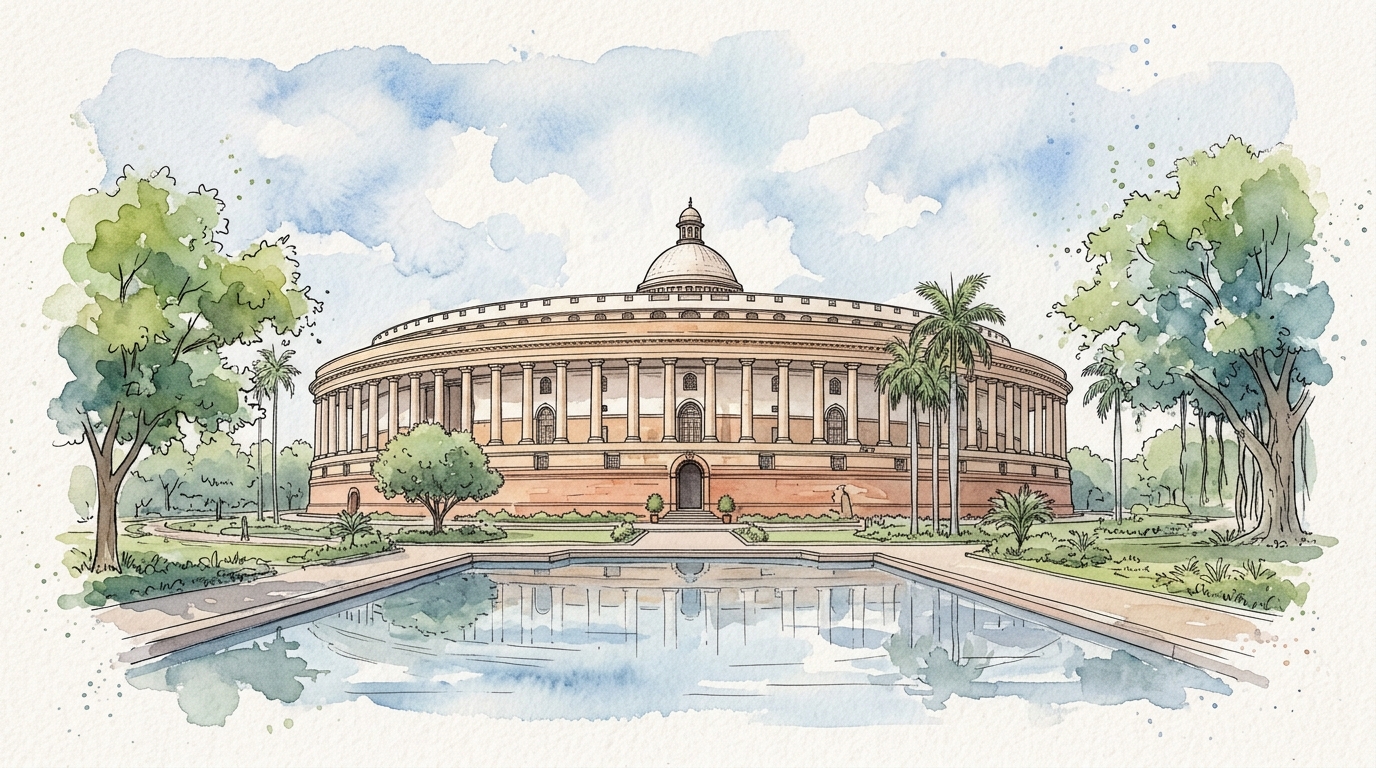
- Core Ratio (1973): In Kesavananda Bharati v. State of Kerala (7:6 majority on 24 April 1973), the Supreme Court held that Parliament’s constituent power under Article 368 is wide enough to amend any part of the Constitution—including Fundamental Rights—provided it does not alter or destroy its "Basic Structure".
- Ninth Schedule Cut-Off Date: In I.R. Coelho (2007), the Court ruled that any law placed in the Ninth Schedule after 24 April 1973 is open to judicial review if it violates the Basic Structure.
- Mains Diagram Tip: Always draw a 4-step horizontal timeline (Shankari Prasad 1951 → Golaknath 1967 → 24th Amendment 1971 → Kesavananda Bharati 1973) in the upper half of page 1 to earn an instant +0.5 visual bonus.
- Balanced Critique: Address the "counter-majoritarian difficulty" (unelected judges invalidating constitutional amendments passed by a two-thirds parliamentary majority) while defending it as a bulwark against authoritarianism.
1. The Genesis: Article 13(2) vs Article 368 Tug-of-War (1951–1973)
The Basic Structure Doctrine emerged from a two-decade constitutional tug-of-war between Parliament’s drive for socio-economic land reforms and the Supreme Court’s duty to safeguard Part III Fundamental Rights. Understanding the exact legal distinction between "ordinary legislative power" (Article 245) and "constituent power" (Article 368) is essential for both Prelims MCQs and Mains introductions.
In Shankari Prasad (1951) and Sajjan Singh (1965), the Supreme Court ruled that the word "law" in Article 13(2) applies only to ordinary statutes, not to constitutional amendments under Article 368. However, an 11-judge bench in I.C. Golaknath v. State of Punjab (1967) reversed this by a 6:5 majority, declaring that Fundamental Rights are "transcendental and immutable." Parliament responded with the 24th Constitutional Amendment Act (1971), which explicitly inserted Articles 13(4) and 368(3) to affirm its power to amend any part of the Constitution.
Mention German legal scholar Prof. Dietrich Conrad’s 1965 lecture on "Implied Limitations of the Amending Power" (inspired by Article 79(3) Eternity Clause of Germany’s Basic Law), brought before the 13-judge bench by Senior Advocate Nani Palkhivala.
2. Kesavananda Bharati (1973) & Subsequent Consolidation
Sitting for 68 historic days, a 13-judge bench in Kesavananda Bharati overruled Golaknath while striking a golden middle path: it upheld the validity of the 24th Amendment, affirming that Parliament can amend Fundamental Rights, but drew an inviolable red line—"amendment" cannot mean "destruction" or "abrogation" of the Constitution’s foundational identity.
First application of the doctrine to strike down Clause 4 of the 39th Amendment, affirming Free and Fair Elections and Rule of Law as part of the Basic Structure.
Struck down Sections 4 and 55 of the 42nd Amendment, declaring that "a limited amending power is itself a basic feature" and establishing harmony between Part III and Part IV (DPSP).
Elevated Federalism, Secularism, and Parliamentary Democracy to Basic Structure status, curbing arbitrary imposition of President’s Rule under Article 356.
Struck down the 99th Constitutional Amendment Act, holding that primacy of the judiciary in judicial appointments is integral to Judicial Independence.
3. Critical Appraisal: Democratic Legitimacy vs Constitutional Survival
Critics argue that the Basic Structure Doctrine lacks textual grounding in the original 1950 Constitution, effectively rewriting Article 368 and creating a "tyranny of the unelected" where a case-by-case judicial catalogue restricts parliamentary sovereignty (as seen in the striking down of the 99th Amendment passed nearly unanimously by Parliament and ratified by state legislatures).
Yet comparative constitutional history across South Asia proves its indispensable value: whereas neighbouring post-colonial democracies suffered repeated constitutional abrogations, India’s Basic Structure Doctrine acted as a safety valve—preserving both socio-economic adaptability (over 106 amendments enacted) and core democratic freedoms.
Evolution of Amending Power & Judicial Review Across Landmark Cases
| Landmark Case / Amendment | Can Parliament Amend Fundamental Rights? | Constitutional Outcome / Core Doctrine |
|---|---|---|
| Shankari Prasad (1951) & Sajjan Singh (1965) | Yes (Unfettered under Article 368) | "Law" under Article 13(2) excludes Constitutional Amendments; Parliament holds supreme constituent power. |
| I.C. Golaknath v. State of Punjab (1967) | No (Prospective Overruling applied) | Fundamental Rights held "transcendental"; Amendments treated as "law" under Article 13(2). |
| 24th Constitutional Amendment Act (1971) | Yes (Restored explicit power) | Inserted Article 13(4) and amended Article 368 marginal note from "Procedure" to "Power of Parliament to amend". |
| Kesavananda Bharati (24 April 1973) | Yes, subject to Basic Structure | Upheld 24th Amendment but ruled that constituent power cannot abrogate the Basic Structure of the Constitution. |
| Minerva Mills (1980) & Waman Rao (1981) | Yes, within Judicial Review & Harmony | Struck down Art. 368(4)-(5); held Part III & IV are "two wheels of a chariot" and fixed 24.04.1973 as the Doctrine of Severability cut-off. |
"Parliament’s power to amend the Constitution is a limited power and it cannot be enlarged into absolute power." In the light of this statement explain whether Parliament under Article 368 of the Constitution can destroy the Basic Structure of the Constitution by expanding its amending power? (15 Marks, 250 Words)
Write this answer on paper and upload to Acme AI for On-Script Red-Pen Checking, or use our 1-Click Answer Generator to view a complete UPSC Model Answer alongside Semantically Similar PYQs & Topper Copies.
Frequently Asked Questions
What is the exact cut-off date for Ninth Schedule judicial review under the Basic Structure Doctrine?
24 April 1973—the date of the Kesavananda Bharati judgment. In Waman Rao (1981) and I.R. Coelho v. State of Tamil Nadu (2007), a 9-judge bench ruled that any law inserted into the Ninth Schedule after 24 April 1973 is subject to judicial review on the touchstone of the Basic Structure Doctrine and Articles 14, 19, and 21.
How can I get my handwritten answer on the Basic Structure Doctrine checked with red-pen annotations?
Upload a smartphone scan or PDF of your answer to Acme AI (/ai-mains-evaluation). Our Red-Pen AI engine places ticks, underlines, and margin remarks directly on your handwritten sheet—and lets you generate a 1-Click UPSC Model Answer with similar PYQs and real Topper Copies.