
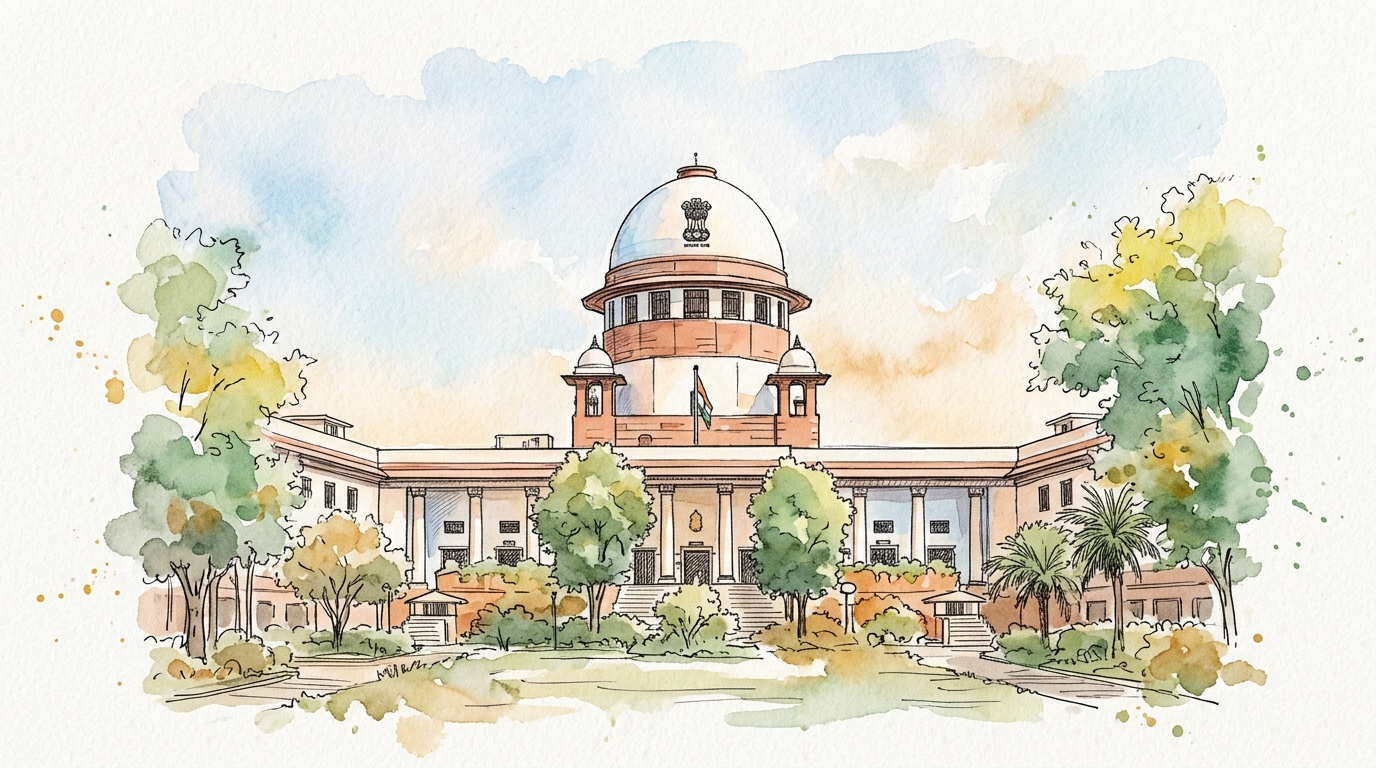
- Definition for Mains Intro: Constitutional morality means adherence to the core norms, spirit, and foundational values of the Constitution—going beyond literal text to uphold liberty, equality, fraternity, and institutional restraint.
- Historical Anchor: Coined by English historian George Grote and introduced into Indian constitutional jurisprudence by Dr. B.R. Ambedkar in the Constituent Assembly on 4 November 1948.
- Judicial Evolution: Transformed from an administrative restraint principle (Naz Foundation, Manoj Narula) into a transformative rights shield against majoritarian or patriarchal customs (Navtej Singh Johar, Sabarimala, Joseph Shine).
- Examiner Caution: Never write a one-sided eulogy—always include the counter-concern of "judicial overreach" and lack of objective definition highlighted by K.K. Venugopal and Justice Indu Malhotra’s dissent.
1. What is Constitutional Morality? (Write-Ready 30-Word UPSC Introduction)
In UPSC Mains GS Paper 2, examiners penalize generic definitions that equate constitutional morality merely with "following the law." At its core, Constitutional Morality is the substantive fidelity to the emancipatory values enshrined in the Preamble and Part III of the Constitution—such as individual dignity, pluralism, non-discrimination, and rule of law—even when social or majoritarian customs push in the opposite direction.
When Dr. B.R. Ambedkar invoked Athenian historian George Grote in the Constituent Assembly (1948), he warned that "constitutional morality is not a natural sentiment; it has to be cultivated. We must realize that our people have yet to learn it. Democracy in India is only a top-dressing on an Indian soil, which is essentially undemocratic." For Ambedkar, it meant reverence for constitutional forms, peaceful resolution of dissent, and refusal to let any institution claim absolute, unchecked authority.
"Constitutional morality, envisioned by Dr. B.R. Ambedkar as the paramount reverence for constitutional spirit over majoritarian sentiment, acts as a transformative judicial compass ensuring that social customs bow before Part III fundamental rights."
2. Core Pillars of Constitutional Morality in Indian Jurisprudence
Through successive Constitution Bench rulings between 2014 and 2025, the Supreme Court of India has crystallized four operational pillars of constitutional morality that you should diagram as a 4-node hub in your Mains answer sheet:
Recognizing that the Constitution was designed to transform a hierarchical society into an egalitarian republic (Navtej Singh Johar v. Union of India, 2018).
Fundamental rights of an individual or microscopic minority cannot be subordinated to "public/popular morality" or age-old patriarchal customs (Joseph Shine, 2018).
Unwritten conventions binding constitutional functionaries—Governors, Speakers, and the Prime Minister—to act with probity (Manoj Narula v. Union of India, 2014; NCT of Delhi v. Union of India, 2018).
Once a constitutional right is recognized and expanded, the State cannot regress or dilute its substantive guarantee without compelling constitutional necessity.
3. Landmark Supreme Court Judgments to Cite Underlined in Red Pen
UPSC evaluators scan GS2 answers in under 90 seconds. Citing bare concepts without case law caps your score at 4/10.Citing 3–4 precise judgments with 1-line ratio decidendi pushes your score to 6.5+/10:
Held that constitutional morality requires the Prime Minister to avoid appointing Ministers with framing of serious criminal charges, even where the bare text of Article 75 is silent.
Defined constitutional morality as a "second basic structure" that checks arbitrary exercise of discretionary power by the Lieutenant Governor against an elected legislature.
Decriminalized consensual same-sex relations under Section 377 IPC, ruling that constitutional morality must prevail over social/popular morality.
Interpreted the term "morality" in Articles 25 and 26 as "constitutional morality" rather than localized religious or customary morality.
4. Critical Evaluation: Judicial Compass or Unruly Horse?
For 15-mark analytical questions ("Critically examine..."), devoting 30% of your word budget to constitutional critiques is mandatory. Former Attorney General K.K. Venugopal famously cautioned that unbridled reliance on constitutional morality risks becoming a "dangerous weapon" of judicial subjektivism, because its contours are nowhere defined in the Constitution.
Similarly, Justice Indu Malhotra’s lone dissent in Sabarimala argued that in a pluralistic society, applying rigid judicial tests of rationality to deeply held faiths without clear textual anchors could erode religious autonomy under Article 25. The balanced conclusion for your UPSC answer must advocate for a "disciplined constitutional morality" anchored strictly to the Preamble, Basic Structure, and explicit Fundamental Rights.
Constitutional Morality vs Popular / Social Morality (Direct UPSC GS2 Comparison Matrix)
| Dimension | Constitutional Morality | Popular / Social Morality |
|---|---|---|
| Primary Source of Authority | The Preamble, Part III (Fundamental Rights), Part IV (DPSP), and Basic Structure doctrines. | Majoritarian social norms, cultural traditions, religious customs, and prevailing public sentiment. |
| Core Orientation | Transformative, egalitarian, rights-centric, and protective of individual dignity (Article 21). | Preservationist, collective-conformity oriented, and often resistant to rapid social change. |
| Protection of Minorities | Protects even a "microscopic minority" against majoritarian prejudice (Navtej Johar, 2018). | Tends to reflect the preferences and biases of the dominant social or demographic group. |
| Mode of Enforcement | Enforced by Constitutional Courts via judicial review (Articles 32 & 226) and institutional conventions. | Enforced informally through social sanction, ostracism, or uncodified customary practices. |
| UPSC Mains Application | Cite in questions on Gender Justice, LGBTQ+ rights, Governor’s role, and Decriminalization. | Cite as the sociological constraint requiring persuasion, behavioural change (GS4), and legal reform. |
"‘Constitutional Morality’ is rooted in the Constitution itself and is founded on its essential facets. Explain the doctrine of ‘Constitutional Morality’ with the help of relevant judicial decisions."
Write this answer on paper and upload to Acme AI for On-Script Red-Pen Checking, or use our 1-Click Answer Generator to view a complete UPSC Model Answer alongside Semantically Similar PYQs & Topper Copies.
Frequently Asked Questions
Is Constitutional Morality explicitly mentioned in the Constitution of India?
No. The exact phrase "Constitutional Morality" is not explicitly written in the text of the Indian Constitution. However, the word "morality" appears four times—in Articles 19(2), 19(4), 25(1), and 26—which the Supreme Court (in Sabarimala and Navtej Johar) has authoritatively interpreted to mean Constitutional Morality rather than popular morality.
How does Acme AI evaluate GS2 answers on doctrines like Constitutional Morality?
When you upload your handwritten answer to Acme AI, our Red-Pen AI engine places annotations directly on your script—ticking landmark cases (e.g., Navtej Johar, Manoj Narula), flagging missing counter-arguments (like Justice Indu Malhotra’s dissent), and generating a 1-Click UPSC Model Answer alongside semantically similar past PYQs and real Topper Copies.
Which UPSC Mains PYQs have directly asked about Constitutional Morality?
UPSC Mains 2021 (GS2, 10 Marks) asked candidates to explain the doctrine of Constitutional Morality with relevant judicial decisions, and UPSC Mains 2019 (GS4 Ethics, 10 Marks) asked what is meant by "constitutional morality" and how one upholds it.