
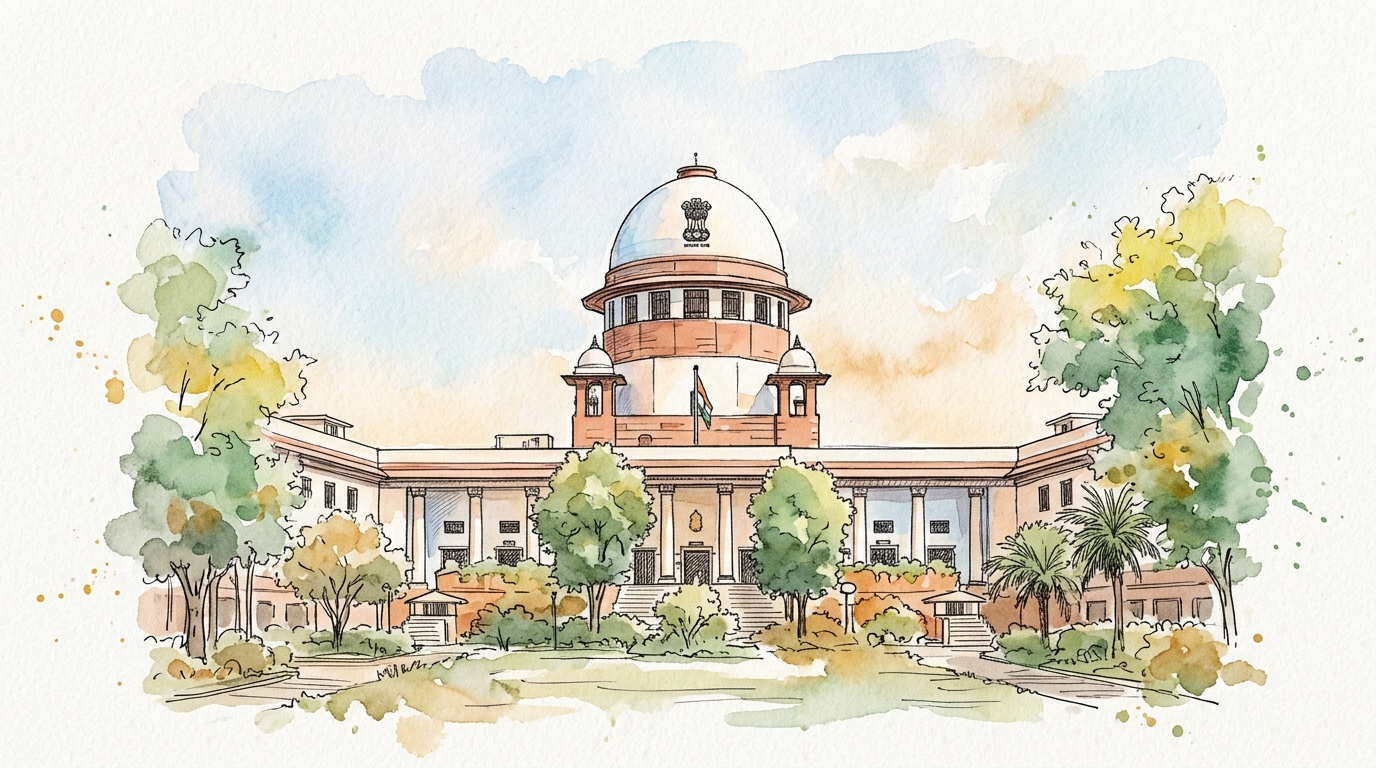
- The 3-Stage Spectrum: Judicial Review (constitutional power under Articles 13, 32, 226 to test validity of laws—part of Basic Structure per L. Chandra Kumar, 1997) → Judicial Activism (proactive interpretation of Article 21 & locus standi relaxation via PIL) → Judicial Overreach (encroaching upon pure executive/legislative domains in violation of Separation of Powers).
- Article 142 ("Complete Justice" Sword & Shield): Used progressively in Vishaka (1997 workplace harassment guidelines) and Bhopal Gas tragedy, but criticized for overreach in cases like the highway liquor ban, banning firecrackers, or micro-managing BCCI/executive appointments.
- Quote for Mains Conclusion: Quote former CJI Justice A.S. Anand (or Justice S.H. Kapadia): "Judges must exercise judicial restraint and remember that the court is not a third chamber of the legislature; judicial activism unchecked by restraint becomes judicial adventurism."
1. From Formalism (A.K. Gopalan, 1950) to Activism (Maneka Gandhi & PIL)
In the first two decades after 1950, the Supreme Court interpreted "procedure established by law" in Article 21 narrowly (A.K. Gopalan v. State of Madras, 1950). The watershed came in Maneka Gandhi v. Union of India (1978), where the Court infused " substantive due process" into Article 21—holding that any law depriving personal liberty must be fair, just, and reasonable.
Simultaneously, Justices P.N. Bhagwati and V.R. Krishna Iyer democratized access to justice by relaxing the traditional rule of locus standi in Hussainara Khatoon (1979) and S.P. Gupta (1981), birthing Public Interest Litigation (PIL) and "epistolary jurisdiction" to protect bonded labourers, undertrial prisoners, and the environment.
2. Crossing the Rubicon: When Judicial Activism Turns Into Overreach
While judicial activism filled an "executive vacuum" to protect fundamental rights, critics argue that routine invocation of Article 142 and continuing mandamus has occasionally blurred the constitutional Separation of Powers (Article 50; Ram Jawaya Kapur, 1955):
Issuing detailed operational mandates—such as banning liquor vends within 500 metres of highways, fixing green cracker barium formulas, or constituting Special Investigation Teams (SITs) for routine administration—without fiscal accountability.
In State of Uttaranchal v. Balwant Singh Chaufal (2010), the Supreme Court itself lamented that frivolous PILs clog constitutional dockets (where 80,000+ cases pend) and stall critical infrastructure projects.
In Divisional Manager, Aravali Golf Club (2007), the Court emphasized that organs of the State must respect institutional comity; the remedy for executive inefficiency lies in electoral and parliamentary accountability, not judicial takeover.
Judicial Review vs Judicial Activism vs Judicial Overreach (UPSC GS2 Comparison Matrix)
| Dimension | Judicial Review & Activism (Legitimate) | Judicial Overreach / Adventurism (Problematic) |
|---|---|---|
| Constitutional Basis | Articles 13, 32, 136, 142, 226; Basic Structure Doctrine (Minerva Mills, L. Chandra Kumar). | Exceeds the boundaries of Separation of Powers (Article 50) by assuming executive/legislative roles. |
| Trigger & Justification | Legislative vacuum (Vishaka v. State of Rajasthan, 1997) or gross violation of Part III rights of voiceless groups. | Substituting judicial preferences for valid executive policy choices where no constitutional violation exists. |
| Democratic Accountability | Protects counter-majoritarian rights and constitutional supremacy. | Judges are insulated from electoral and budgetary accountability for the fiscal fallout of policy orders. |
| Illustrative Cases | Hussainara Khatoon (speedy trial), K.S. Puttaswamy (privacy), Navtej Johar (equality). | Mandatory national anthem in cinemas (later modified), highway liquor ban, micro-managing sports bodies. |
"Judicial legislation is antithetical to the doctrine of separation of powers as envisaged in the Indian Constitution. In this context justify the filing of large number of public interest petitions praying for issuing guidelines to executive authorities." (15 Marks, 250 Words)
Write this answer on paper and upload to Acme AI for On-Script Red-Pen Checking, or use our 1-Click Answer Generator to view a complete UPSC Model Answer alongside Semantically Similar PYQs & Topper Copies.
Frequently Asked Questions
What is Article 142 of the Indian Constitution and why is it important for UPSC Mains?
Article 142(1) empowers the Supreme Court to pass any decree or order necessary for doing "complete justice" in any cause or matter pending before it. In UPSC Mains GS2, it is frequently examined both as a progressive tool to fill legislative vacuums (such as the Vishaka guidelines before the POSH Act 2013) and as a potential vehicle for judicial overreach when used to bypass statutory provisions.